A year ago my academic web site disappeared. And those who made it go away probably ignored that such a thing could happen. This is an anecdotical and introspective tale about why you should (perhaps) not trust your (web) content to a university. Or any kind of institution for that matter. Because if you do, your stuff may just disappear. And there is nothing you can do about it.
Science used to mean paper
In the old days (academic) knowledge was captured and disseminated through paper, dominantly in the forms of journal articles and scientific books. Typically they were printed and distributed by independent commercial publishers. An important task of university libraries have been to gather such works and make them available to researchers and students. More recently various forms of electronic media, including the Web, have supplemented this flow of academic information. For a long time one major concerns has been the longevity of e-media, compared to books. But maybe we face other challenges within a much shorter time frame.
Social media in a scientific context
With the advent of Internet, the Web, and now ”social media” anyone may publish their thoughts, notes, reflections, conversations, interactions, and behavioral patterns. Including of course academic work. We may do it through social media services, at our own/hosted web servers, etc. Numerous are the blogs, forums, communities, research networks, etc. where scientist converse about and disseminate their work. Sometimes those media resides within the domains of universitites. Well, this subject is kind of huge so I pause here for the moment (but will end with a link to some older thoughts of mine).
One student published his work at his university
 Around 15 years ago I decided to start a reseach project in Business Administration. At that time I had spent a number of years at the School of Business, Stockholm University. First as a student, later as a part time systems developer and an assistant professor in Marketing. My decision to pursue a PhD was heavily influenced and supported by professor Bo Hedberg, who also became my supervisor.
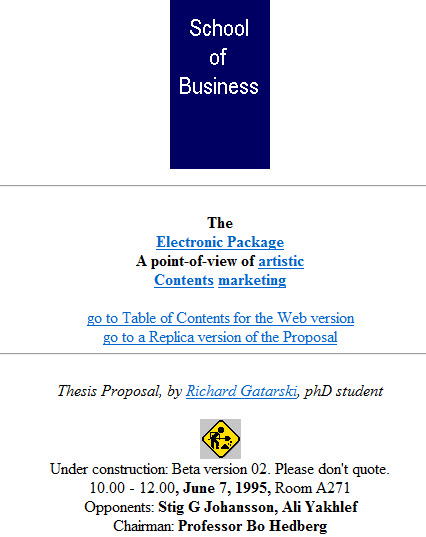
I won’t go into details about my ideas around the form of my dissertation. Suffice to say here is that I put various drafts of my research proposal on the Web. Because my department did not have a web presence at that time, I published the stuff on my (and my business partners) domain bat.se. I defended a beta version June 7, 1995. And the proposal is still to be found at the bat site (including a now defunct version in the Replica format).
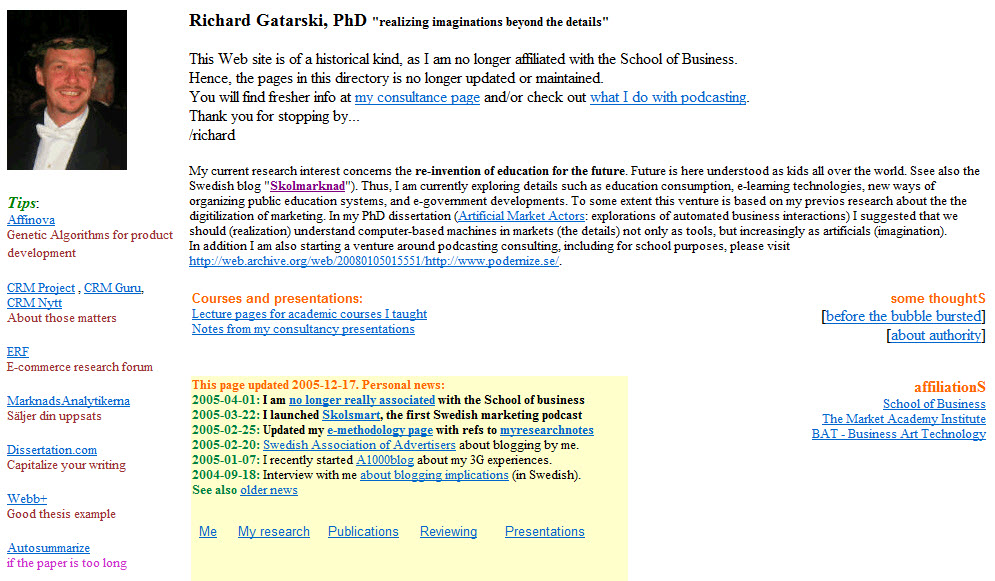
 Time went on, and as soon as the School of Business provided some web space for us doctoral candidates I begun documenting my research at www.fek.su.se/home/rgi (no link, I’ll tell you why in a moment). One of the first things I put there was ”Contents Management, Imaginary Organizations, and Agents as Consumers: How IT could shape the Market in 2019”. That was the manuscript for a book chapter that I wrote in 1995, together with professor Hedberg. Ironically, the orginization who ordered the chapter never published the book. Too many contributors never delivered, but we delivered immediately on the Web. I kind of felt proud when my stuff for a while generated most of the incoming traffic at www.fek.su.se.
Ten years of Web publications vanished
Last fall (2008) I found out that the School of Business had redesigned their web site. And in the process they just ignored my research. About ten years worth of virtually daily updates were gone! That included most of the manuscripts for my published work. The same thing happened to lecture notes, powerpoint slides, course documentations, useful links, etc. It had all disappeared from the Web.
As soon as I learned about this I sent an e-mail to info@fek.su.se (and as far as I can remember a similar note to Stockholm University’s communications department). I told them that I my stuff was gone, and asked if they had any comments. Appearantly not, as they never replied. I am still deleted. In fact, if you search for my name it looks like that I have never been there. Thank you School of Business :-(
In non-universities we may trust
 Courtesy of the Internet Archive you can still find most of my academic stuff on the Web through their Wayback machine. For example the book chapter ”Contents management…”, various archives of my academic web site, including the most recent version from January 2008 (although I stopped updating it in 2005 when I left the departement). The Internet Archive is ”a 501(c)(3) non-profit that was founded to build an Internet library”. Dah! What happened to the responsability of the University (Library)?
One major problem though, is that none of the links pointing to my research at www.fek.su.se/home/rgi works. For example, links to the 1997 paper ”Interactive Media Face Artificial Consumers” (archived here), which currently is becoming highly contemporary (why in a later post).
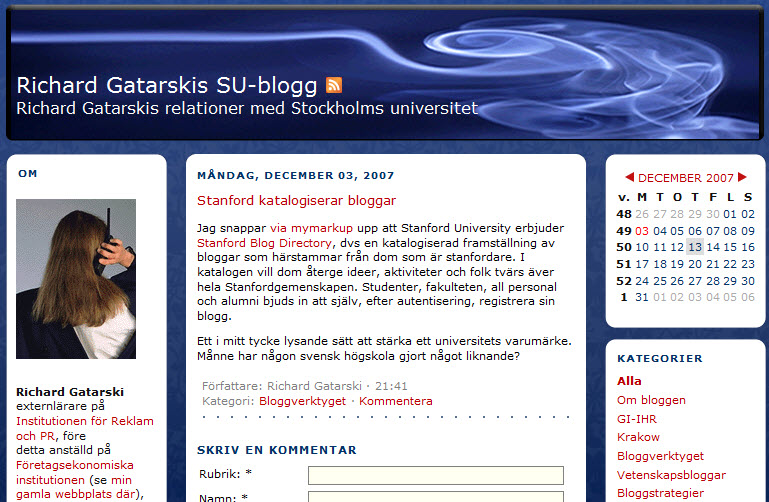
 The sad story does not end here. Late 2006 Stockholm University begun offering their faculty and students a blogging service at blogs.su.se. At that time I still had some minor assignments as an assistant professor. So I decided to try out their blogging platform and launched ”Richard Gatarskis relationer med Stockholms Universitet” at blogs.su.se/rgi (no link, guess why). Within a short time my blog there was one of the most read ones, right behind the Vice-Chancellor’s. Then during the summer of 2008, all my records from the staff directory was removed. Fair, since I no longer worked there. But in practice that meant I could no longer manage my blog, including moderating comments. I pointed that out to the IT and the communications deptartments. Their solution was to simply remove the blog. But guess what. The Wayback machine helps us again. So we can at least read archived versions of blogs.su.se/rgi. Of course none of the existing links to my blog’s original address works.
Similar issues
A couple of years ago I made an experiment at the Department of PR and advertising at Stockholm university. Based on the PBworks platform I attempted to crowd/open-source an academic five week course about ”the individuals role in social media” from scratch. The department paid for a premium wiki and I launched giicod.pbworks.com (Swedish) in August 2007. It was developed and maintained by fellow teachers, students and some other stakeholders. A year later the department said ”dump it”. But I still let it live :-D
Currently, at least in the social media bubble I reside, a story about who keeps the tweeps when a journalist moves from one newspaper to another has caught a lot of attention. It illustrates the problematic social relations between an individial, her organization(s), outside networks and conversationally generated content.
[Update 2009-08-24: I forgot to include Paul Colligans post ”About Podango’s Demise And The Smart Podcaster’s Response” which he published late December last year. Podango was a podcast distribution service that was terminated on an extremely short notice, in effect removing all episodes published by its users. Most likely that was one but the first in a line if similar cases].
Lessons learned and my advice
I no longer follow the developments regarding the scientific information processes and our current media revolution. I once did, and presented ”Marketing Research in the Digital Domain: a cry from a pilrgrim in the late 20:th century”. Perhaps the issues I bring forward today are heavily discussed among university chancellors, political leaders, educational policy makers, and scientific philosophers. But I doubt that. Please enlight me.
Meanwhile, for those of you who publish stuff on the Web while working with an organisation, including universities. Try to put your content where you control it. Most likely you will move between work places, temporary assignments, and soforth. If you want your stuff to be preserved, it is your responsability to make sure it is.




 Inlägg (RSS)