Arkiv för kategorin “weconverse”

Content originally published at weconverse.com
Innehåll ursprungligen publicerat på weconverse.com

Hinner egentligen inte skriva detta, behöver sova och ordna till en kontroll på Scouternas dag, men jag kan inte låta bli.

Steve Rubel (tung kille, lita på mig) skrev för några timmar sen att "The Future is Web Services, not Web Sites". Det vill säga en rörelse mot flyttbara widgets, gadgets, apps, api, rss, mm. Några gånger har jag haft den utvecklingen med i mina gig (ex Webbdagarna och Web Service Award), men i princip bara när jag antagit att folk på plats är rätt uppkopplade. Det blir rätt lätt obegripligt annars, och framförallt fööör mycket. Även om jag ser det som mitt uppdrag att lyfta fram såväl det som är här och finns (även om inte alla liksom upptäckt det) och att antyda en del om vart jag och andra verkar driva utvecklingen.

Åkte annars på en riktig (vänlig) känga om mitt "webbplatsen är på väg ut" idag, under The Conference giget, Magsparken levererades av Anders Gyhlenius (varuhuschef IKEA Kungens Kurva). Jag tackar Anders för den påminnelsen, och framförallt hans varma och engagerade berättelse om sitt, IKEA:s och oss övrigas liv. En kille att beundra (och inspireras av).

Comments Inga kommentarer »

Paul Bradshaw listar på Press Gazette Ten changes in 10 years for Journalists. Först ut på listan är: From a lecture to a conversation:

Perhaps the biggest change in journalism has been the increasing involvement of – and expectation of involvement by – “the former audience”. Readers’ letters and phone-ins were one thing – this new relationship between publisher and reader is something else entirely.

Jag kunde inte låta bli att eka det. Det har tagit så lång tid för journalister att fatta det, om dom och deras redaktörer nu har fattat. Jämför med vad framförallt Sten Svensson på Lärarnas tidning, men även andra, lär ha sagt i en färsk intervjuserie hos Vassa Eggen (tipstack till dom). Min före detta, numera konkursade agent Reality Club, fattade inte heller.

Comments Inga kommentarer »

[Uppdatering efter giget] Whow, vilken kul grej. En dryg timmes ös om podcasting och lite närbesläktat. Härlig grupp unga mediörer, uppvärmda av mitt förband Blondinbella (som jag tyvärr bara hann hälsa på, men inte höra). Nåväl här är  mina föreläsningesbilder (pdf) och några länkar som utlovat. Helt spontant gjorde vi också en liten bambuser livemobilvideostreaming efter lunchen, den finns att beskåda hos dom.

  • Swecasters (mer info om vad & hur samt utvecklande föreningsliv)
  • Podradio.nu (svensk podcastkatalog)
  • Utterz (mobiltjänsten jag använde för att spela in första demon, se även Hipcast)
  • rgatarski demo (bloggen där utterz-prylarna hamnade, jag kommer rensa bort om ett tag)
  • RSS-guiden (min enkla förklaring till vad det är, länkar till Bloglines mm)
  • Mixcraft (ljudredigeringsverktyget jag demade, se även Audacity open source).

Jag har säkert glömt en massa, men det är bara att fråga (kommentera nedan eller kontakt)

Hepp, härliga äro konversationernas vägar. Igår mejlade Swecasters ordförande (jag är medlem genom min och sonen Miltons mors) en undran om jag kunde prata en timme om podcasting på Ung Medias Presskonferensen 2008. Tog ett dygns funderande (det är mycket nu), men jag vill ju gärna. Dessutom är dom som kommer mest skolungdomar som jobbar med skolans medier. Näväl, pratade precis med arrangören och tackade ja. Fick samtidigt höra att timmen före mig berättar Isabella Löwengrip, äks Blondinbella, om blogging och sina erfarenheter inom området.  Kul för mig som kämpar med att komplettera kändisbloggardominansen med annat innehåll. Och för att jag kanske får se vem Mr X är…

Comments Inga kommentarer »

The what is there, why it is important follows here. When we say xxxx, what do we mean?  Consider the sentence:

Regarding the Swedish discussions about Public Service, not a single one of the ideas suggested by Richard Gatarski sucks.

My point here is not the content of the sentence, but its sentiment. That is, "the attitude, thought, or judgment prompted by feeling". I hope that you find my attitude towards my own ideas are pretty positive. In other words – I do not suck.

In a comment to my previous post Adam Nussdorfer suggests that I should do a Google Suck Index (GSI) with "Gatarski sucks". Of course I did, and currently the result is zero hits. The same goes for the Swedish translation "Gatarski suger". Good enough, eh? The only problem is that soon there will be at least one hit (this post). And if one of you blogs about this post and include "Gatarski sucks", Google will have two hits. Long-tailing around for some time and the GSI for my name would at first sight look terrible. So, I need to rewire your brain behind the current blink at GSI.

In a post in his company’s blog Adam refers to the Business Week article Love the customers who hate you. There Jeff Jarvis, famous not only for his Dell Hell experiences, tells the readers to check their GSI. Read the article, because Jarvis’ advice on what to do with angry customers are insightful and valuable. The same goes for the lead story Consumer vigilantes and the podcast episode behind it.

But Google finds words, not sentiment. Hence you must think beyound hit counts – that is the important lesson here. Regarding my little person it does not matter much, because you (if you are human) can easily scan the few hits to grasp the sentiment(s).

Let us take a more complex, yet illustrative, example. A Google search for (without quotation marks): cheap monday are not comfortable, gives me 2.580.000 hits, and cheap monday are comfortable gives 1.660.000 hits.  Do not assume that means that the majority of the Web stuff about cheap monday’s jeans is about how unconfy they are. Actually, the first 10 hits on the "not" search goes to retailers and fashion promoters. Clearly, we (humans) can not analyze the dominating attitude(s) here by looking at hit counts. We need help.

Machines capable of interpreting feelings and meanings have become more important than they were when I defended my dissertation Artificial Market Actors in 2001. The issue of meanings was not in my focus, although I sort of grasped the importance. In other words I am not the expert here, others are (let us know :-).

As I noted a few posts ago (in Swedish), what most likely will come in handy is "Sentiment analysis". According to (the current) Wikipedia definition it is an:

"area of natural language processing, computational linguistics and text mining. Generally speaking, it aims to determine the attitude of a speaker or a writer with respect to some topic. The attitude may be their judgement or evaluation (see appraisal theory), their affectual state (that is to say, the emotional state of the author when writing) or the intended emotional communication (that is to say, the emotional effect the author wishes to have on the reader)."

For sure not a new field, but something I believe anyone interested in market conversations must learn about and contribute to. Note, this goes far beyond Google and similar search engines. Sentiment analysis, and related fields, are useful for intelligence in all kinds of social and other media.

Comments Inga kommentarer »

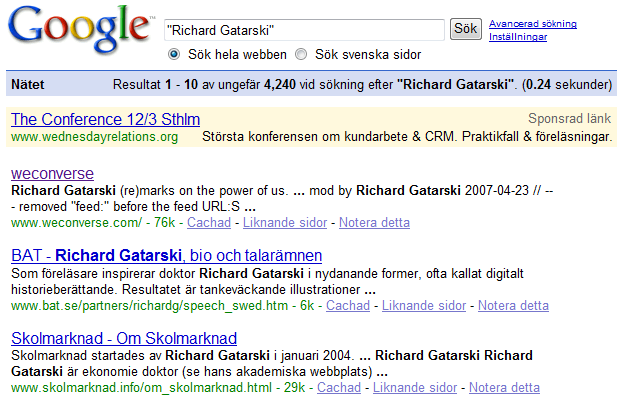
image The other day I was doing some ego surfing or as I prefer to call it, market intelligence. To my surprise, at the top of the Google results list for "Richard Gatarski", I found a sponsored link. Apparently one of my customers bought an adword bundle that includes my name (gig next week at The Conference). That triggered some moments of reflection. Can’t say I am terribly concerned. Rather more thinking about if that (unclear)  is something I could capitalize upon. If nothing else, the other guys at my office envy me. Their names did not reveal any (namenapped) sponsorships. Does your?

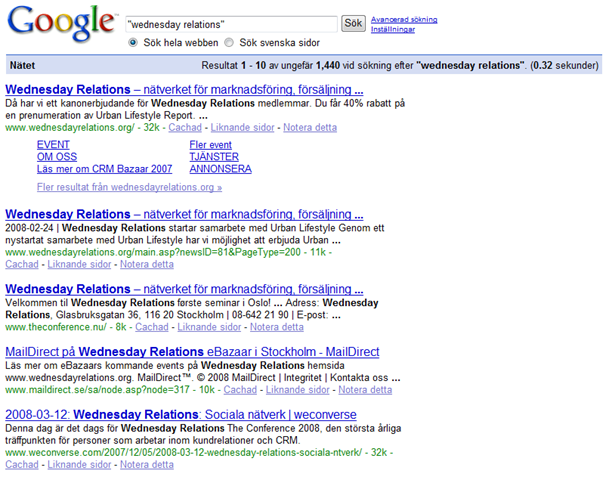
image Now to the even cooler thing. A Google search for "Wednesday Relations",  the name of the company who organizes The Conference, rank the weconverse blog gig entry as number five, and second if one excludes sites owned by Wednesday Relations.

Comments Inga kommentarer »