Arkiv för kategorin “Okategoriserade”

imageDet märks när man bloggar, och det gäller även matematikentusiasm, vilket jag återkommer till nedan apropå Matematikbiennalen 2008 som pågår även idag.

I går fick jag en anonym kommentar på weconverse från någon som startat en spegelblogg av Skandiabankens VD-blogg. Upppenbarligen är den anonyme specifikt lite besviken över Skandiabankens sätt att hantera kommentarer, vilket var en del av det jag förde fram i mitt välkommenterade inlägg Skandiabankens smink, apropå Skandiabanken blogg.

När jag kollade upp spegelbloggen (länkar inte dit förrän jag känner mig säkrare på vad det är för en filur), och VD:ns dito noterade jag att även den senare numera erbjuder RSS, vilket var på tiden. Faktum är att jag efter mitt inlägg totalt ignorerat VD-bloggen eftersom den inte haft RSS. Utöver det passar jag på att dela med mig av min irritation över att när jag numera vill logga in i deras Internetbank så öppnas ett nytt webbläsarfönster – otroligt irriterande.

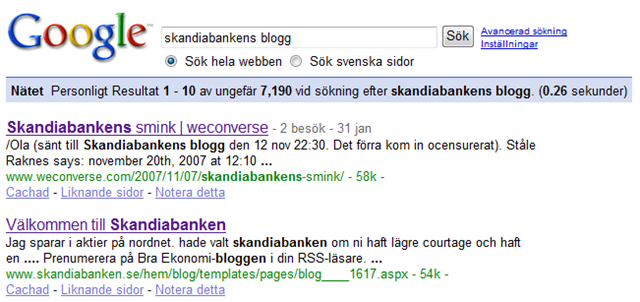
Dessutom passade jag på att googla på "skandiabankens blogg" och "skandiabanken blogg". Ser man på, mitt inlägg är första respektive tredje träff och en hel del av toppträffarna i övrigt relaterar till det jag skrev. Det mina medkonversatörer, är kraften i en blogg.

Låt mig repetera att jag skrev förra inlägget och detta dels för att vi kan alla lära oss av modiga aktörer som Fredrik Sauter på Skandiabanken. Och jag som kund vill bidra med mina tankar om hur dom kan göra bättre, även om dom inte verkar vare sig lyssna eller kommentera. Disclaimer: förra veckan blev jag ombedd av en annan bank att hjälpa dom inom området webb 2.0 och sociala medier.

Mattelust

imageI går eftermiddag publicerade jag på Skolmarknad.info  Matematiklust, första intrycket från Matematikbiennalen 2008. Rubriken inleddes med mattelust av ett speciellt skäl. För detaljer se inlägget, men jag räknar med att fler än jag kommer söka på dom postivia orden, gärna för att visa för andra (som jag gör nu).

Nar jag idag googlar på "matematiklust" går dom första träffarna (indirekt) till det jag skrev. Jag roade mig i morse med att läsa igenoma Metro, Stockholm City, SvD och DN som inte hade ett ord om biennalen, med undantag för Astrid Petterssons debattinlägg.

Comments Inga kommentarer »

Today I learned through futurambs really interesting post Volvo IT blocks sites mentioning "social software", The reason, as echoed by futuramb is:

[weconverse and other sites] is categorised as Social Networking and Personal Sites. Volvo Group provides access to a subset of web sites through its Internet services. Other web site categories are blocked.

So cool, I feel both socially discriminated, and sorry for the folks at Volvo, compare my earlier thoughts on the issue. Perhaps they can find comfort by chewing Ahlgrens candy cars temporarily shaped as Volvo cars (co-branded marketing campaign, most discussed topic right now at the Swedish Bloggportalen).

On a side note, I am currently discussing with a client about a learning project concerning social media for a group of selected managers. We cannot use Facebook, because their enterprise has blocked the access to it. Easy thing to choose another social network – but not for adding value to the project. Rather, the result might be the other way around.

Comments Inga kommentarer »

At this very moment (if we are following the schedule) I am presenting a few glimpes from a fresh survey regarding web trends in Sweden. Earlier this month Web Service Award (WSA) surveyed randomly selected customers with the purpose of assessing how managers responsible for web sites consider the site’s service quality from the visitors perspective. Of the 929 managers who received the web based questionaire 424 responded (45%). The web sites in question are for public use and published by (non-)government organisations as well as commercial enterprises, including e-businesses.

Part of the survey, which also was conducted in 2005 and 2006, concerns web technology trends. For around 10 named, but not described, technologies (e.g. blogging) the managers were asked to indicate their knowledge (none to very well). Those who had at least some knowledge about a particular technology were also asked how their organisations considers it (not interesting to implemented and evaluated). The questions concerns use of the tools at the respondents web site, not the managers personal use.

Here is a brief summary from my personal analysis of the data and later tonight I will publish my slides from the gig. Please note, it is a quick-and-dirty analysis with possible errors. The full report, which also compares the managers responses on service quality with those from actual web visitors, will soon be available upon request from WSA (in Swedish I guess). Disclaimer: I have adviced WSA on what they should survey about, I am in the WSA jury, and I moderate their awards event.

Communities is not so very popular. Unfortunately the question about knowledge of communities as a web technology disappeared this year. But 344 respondents answered on how they considered the use of communitites. 17% said not interesting, 42% relatively low priority, 23% are closely monitoring the development, 11% have actual plans to implement, 3% have implemented but not evaluated, and 4% have implemented and evaluated communitites.

Blogging is well known, but not popular to use. 93% had at least some knowledge. The trend from 2005 is strong knowledge improvement, but still less than 50% answers ”know very well”. The organisations seems to give blogging some priority and the trend is increased implementation, even though more than 50% of those who know about blogging overlooks blogging, i.e. answers not interesting or give it relative low priority.

RSS is well known, fairly prioritized and undergo implementation. 81% had at least some knowledge, hence the awareness is good and have been increasing since 2005 when 50% knew nothing about it. RSS seems to be more popular to use than blogging and over 40% of those who know about RSS have implemented it. Less than 10% find it not interesting.

Wiki is known, but relatively ignored. 70% had at least some knowlededge, up from less than 30% two years ago. Still virtually none of the organisations had implemented wikis and close to 67% found it not interesting or gave it low priority. Since 2005 the interest to closely monitor the development (27%) has more than doubled (from 12%).

Tagging is known, but gets low priority from but a few. 69% had at least some knowledge and the trend is increased understanding from 2005. Still almost 48% of those who know about tagging more or less overlooks it and around 20% will, or have, implemented it.

Web 2.0 is known and monitored, yet not very implemented. 67% had at least some knowledge, up strong from 30% in 2005. Interestingly enough 56% responded that they knew about Web 2.0 fairly or very well. After all, it is controversial and vague concept. Nevertheless of those who know about Web 2.0  few (5%) had implemented it, but 25% had actual plans for implementation.

VOIP is still not more than known. 67% had at least some knowledge. The trend from 2005 is deeper knowledge rather than more wide spread, as fairly to very well has risen from 25% to 43%. Still virtually no one who knows about VOIP have implemented it. And VOIP is more or less overlooked with the exception of the 15% who closely monitors the development.

Podcasting is becoming more known, but ignored. 67% had at least some knowledge, slightly up from 50% in 2005. Still the majority (72%) of those who knows about podcasting finds it uninteresing or gives it low priority.  Around 10% plan to, or have, implemented podcasts.

Widgets/gadgets is barely known and ignored. 52% had at least some knowledge, and this question was new with the 2007 survey. Close to 60% of those who know about widgets/gadgets overlooks them, no one has evaluated it and less than 14% plans to, or have, implmented widgets.

Affiliation program is not so known and not so interesting. 37% had at least some knowledge, slightly up from 28% in 2005. Of those who know about affiliation programs 67% overlooks it and 10% have implemented it. Note, only 35% of the surveyed web sites have marketing or e-business purposes.

Mashups mostly unknown, gets low priority or is monitored. Only 32% had at least some knowledge and this question was new in the 2007 survey. Of those 7% hade very good knowledge and 13% fairly good. 5% of those who knows about mashups have actually implemented it, and close to 50% more or less overlooks mashups. Still, around 40% are closely following the mashup development.

Of course all the above would be interesting to discuss further. I squeezed writing this entry into my schedule with no time for reflections. But after its publication we can all converse about reasons and meanings…do you want to?
Comments Inga kommentarer »

Knowledgeable in the fine arts is something one cannot call me. Nevertheless I have read Paulo Coelho’s the Alchemist and I am aware of that he has received used to think that he had received the Nobel Prize in literature.

Monday evening Martin Källström reported from the Digital Life Design (DLD) conference in the super(secret) PPlist. According to DLD it is ”Europe’s conference for the 21st century, covering digital innovation, science and culture”. Martin was there, and according to another member of the list he was ”typing every second”.

So, here is my first point. Martin is educated , connected, and social. Even though he is in a meeting – he is conversing with the outside world. If that was not the case you would not have read this. Beyond that he is an entrepreneur (co-founder of Primelabs, commented by Techcrunch yesterday).

Martins report was one of the best of its kind (wide coverage, broad, quick, short, and focused). I found value in every word. Let me share what Martin wrote about Paulo Coelho’s session (I got Martin’s permission to republish it here). Coelho (conference bio)  presented in the Creating Universes track. Ignore Martin’s typos, this is not an excercise in English, it is immediate reporting. Hopefully DLD will publish videos from the sessions, including Coelho’s, in the near future.

Pauolo Coelho made a very interesting and catching talk about how he uses the internet in surprising ways for a writer. I didn’t write it down so here’s a summary from memory:

”For books, the Internet has an impact in three areas: Language, Distribution, Social Interaction.

Some people think that internet destroys or deteriorates language with people writing 4 instead of ”for” or U instead of ”you”. But language is a living thing, I do not think internet is destroying language. And the fact is that people are reading more now than they ever hav done.

And writing more, in emails and IM and so on.

I use internet for distribution. I released one book exclusively on the internet and we had an amazing 1 million downloads. But even though this is a very high number, I didn’r receieve a single comment on the book. No one was actually reading the book, In 2001 we had really no readers in Russia. My best seller The Alchemist was selling a 1000 copies per year. And then it was pirated on Bittorrent and people started to download it. The next year it sold 10 000 copies, the next year 100 000 copies and today we have sold over 10 million copies in Russia.

But when I wanted to start to distribute my books over the Internet my publishers told me that I donät have the rights to the translations and so forth. So what I did was that I collected all bittorrents of my pirated books and put them on a website called Pirate Coelho. And I started to link to this page from my own blog, I have a link on my main page. And people are downloading my books very much trough this site. But I can’t tell this to my publishers because I don’t have the rights. So whenever they create a translation of a book to a language, say Portuguese, I ask to review it before printing and then I immediately release it on Bittorrent. I don’t know if the publishers have spotted this scheme but at least they don’t say anything.

Being a writer is a very lonely business. You sit alone and write.

Internet allows social interaction and through my blog I now have houndreds of thousands of people contacting me. Last year I invited 10 of my readers to a party and this year it’s going to be a hundred readers at a party in Paris.

Time for my next point. It is not the Producers (publishers and authors) that are in the driving seat. This case is just another illustration. But what an illustration! And note the amount of braveness Coelho demonstrate. He must be very well aware of the dangers of telling folks outside the connected world, who through their disconnectedness probably have missed what Coelho has already done.

Too many book authors refuse to both utilize what consumers are doing with their work and are afraid of letting control. Most likely that crowd include writers of educational literature. Furthermore, school teachers are obsessed by correct spelling, without respect for the dynamic evolution of Language. That is why I qouted Coelho in my gig för IPON 2008 this morning.

Thank you Paul. Thank you Martin. You are more than I. As a result of your inspiring ventures We are growing. I wish political legislators would understand this view on the world, and not only the Publisher/Producers desperate attempts to preserve old thinking.

Meanwhile, you can taste Celho’s stuff at Pirate Coelho.

Comments Inga kommentarer »

Via en inbjudan i Facebook till eventet Tillgänglighet 2.0 – the user experience får jag reda på detta heldagsseminarium som verkar mycket intressant. Key note är webbstrategen Per Axbom och i övrigt pluggar arrangörerna sina verktyg för talsyntes och liknande. Phoneticom, en av dom som står bakom seminariet, bjuder även in via inlägget Accessibility 2.0, the user experience.

För mig är tillgänlighet viktigt och talsyntes har visat sig vara populärt även för att göra podcasts av bloggar, inklusive weconverse. Jag har anmält mig – vi kanske ses där?

Comments Inga kommentarer »