[Update after the gig] Here are my slides (pdf) and now I will make sure they go to the EMAN USB stick as well. Thank you for some intense 30 minutes…
The International Programme Office for Education and Training (Programkontoret) contacted me a couple of weeks ago and asked if I would be interested in giving a presentation at one of their meetings. The European Mobility Alumni Network (EMAN) is a project for the corresponding offices in Hungary, Italy, Norway, and Sweden. No, I do not know if they have a web site, googled and could not find any.
November 22-23 representatives are meeting in Stockholm for the LLP Greenhouse for sustainable networks (LLP=Lifelong Learning Program). The aims of the meeting are:
gather and disseminate experiences from study tours/courses
facilitate personal networks for future collaborations
create shared platforms for common interests
Those who know me might guess what I think when I read ”The results [from projects] will be presented in a CD to be distributed to NA:s as well as study visit and course providers”. In any case, I have on short notice happily accepted to share my personal experiences, as I have learned a lot from similar, but Web 2.0-based, ventures in the area of future learning. In short my idea is to use my 30 minutes to:
present an overview of social media and Web 2.0 technologies
illustrate how grassroots use that stuff to converse about the re-invention of learning
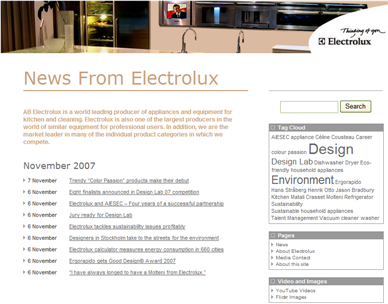
Yesterday I learned through Dagens Media that Electrolux today launches a social media newsroom. (For an overview in Swedish what this is all about, see my post Neo PR hos GM Europa, Cisco och Virgin Entertainment). I immediately tried to locate Electrolux’s interesting step on the Web (Dagens Media as many other traditional media is not keen on providing outgoing links). No success, until I asked a friend who I know advises Electrolux. He pointed me to newsroom.electrolux.com.
I like it a lot. Primarily because a Swedish (well…) major enterprise takes a step in this direction relatively early on. And while doing so humbly search for a good approach without drumming on how fantastic and innovative they are. Rather Electrolux now introduces a range of social media related functionalities and remarks (through my friend) that they have a growing list of things they want to add. For example, allowing comments. Perhaps it would be a nice thing if they offered stakeholders (bloggers, journalists, consumers, etc.) a wiki from which their newsroom project could be further informed.
The first thing that strikes me as novel (and different from traditional newsrooms) is the tag cloud. For a savvy visitor like me I appreciate the clean and organized layout. I quickly grasped (trough head lines in the right column) that they currently offer:
Tag Cloud (where most is about ”Design”)
Pages (links to core stuff for a newsroom)
Videos and Images (YouTube and Flickr are their chosen services)
More links (to Electrolux brand web sites)
More blogs (search feeds from Engadget and Gizmodo)
Subscribe (the newsroom via Feedburner services, and from YouTube/Flickr)
Of course there are news, at the moment with only nine items. Perhaps Electrolux will populate it with old news. Perhaps they will just add new news. In any case, it was easy for me to read all the news. Generally we find a title, an ingress, a number of paragraphs with text, of which some embeds links, and a few photos. None of the news items ends with a ”Fore more information…”. Even though the site offers a Media Contact page, that does not help if one gets the news over RSS. Hence, I still believe that contact information should be a part of the news entry.
Here comes my first disappointment. The newsroom is built with WordPress, and it would have been an easy thing to add a plug-in (e.g. Share This) that adds social media functions that facilitates sharing of the news content. (see Anders Edholms comment) I actually tried posting a news URI to my wall in Facebook. As you can see the Facebook app could not locate any graphics, which probably is OK. Possibly more important is the missing headline Should have been ’Trendy Color Passion products make their debut’ instead of the generic ’newsroom.electrolux.com’. All in all, this suggests that the newsroom is not optimized for search engines.
What also strikes me is that there is virtually no educational information. That is, explanations to visitors what this kind of newsroom is all about. True, there is an About this site page. But it just informs us about that the whole thing is protected by a Creative Commons license. In my view that´s OK. There is a sufficient numbers of social media enthusiasts that knows what to do. For a geek like me it would have been nice with a brief overview of how the newsroom is built (even though I believe I have hacked the most important stuff already).
There is no (traditional) press release at Electrolux.com about the new newsroom. But through Dagens Media we can learn that the site has ”been developed with a low budget by two employees with Electrolux and advice from an external consultant” (my translation). The current ambition is that one editor in the USA and one in Sweden will publish news items twice a week.
Now it is up to all of us to make the most of this.
[Update 14:40] I forgot to mention that the Swedish PR service Newsdesk for quite a while offers social media functions in their clients newsrooms. For example, Multimedia News Releases and Video releases.
[Updated 17:05 after Electrolux fixed the bug with Share-This]
I stumbled upon the entry Playstation Home in Wikipedia, currently described as "a community-based service for the PlayStation Network which has been in development since early 2005".
What fascinates me is neither that Playstation Home will feature a lot of advertising space, nor that an encyclopedic entry covers a very commercial product. Encyclopedias are supposed to cover everything, including branded stuff. It is also (increasingly) common knowledge that people have for a very long time used social media (discussion boards, blogs, wikis, etc.) to converse about products that are in the market.
The new, and most interesting, idea for me (at least) is that an encyclopedia describes something that does not yet exist. Without getting too philosophical, I used to think of an encyclopedia as a source of knowledge about what exists. The known could thus be shared and distributed over time and space. I have also become used to acknowledge the power and usefulness of an encyclopedia (like Wikipedia) that is in pace with state-of-the art knowledge (about what is).
But here an encyclopedia starts to describe something that does not exist. Knowledge about something that is to become. And as a result the becoming may very well be re-defined by the knowledge about something that is not.
[Updated 2007-10-29: Added about Viddler under the ”Going forward” section below]
It feels good to share, but videos should be carefully shared by conversations-, communications-, and PR- professionals. You may have seen and understood the possibilities, but most of us seems not to have considered the drawbacks. In particular when it comes to ”free” services like YouTube (compare Bubblare or FejmTV in Sweden). Please note, my focus here is on solutions that are supporting the sharing, i.e. forwarding, viral spread, and/or social networking of/with your videos. Not video file distribution or basic video streaming. If you want the skip my backgrounder, jump right down to THINK.
I am greatly inspired by the fantastic social media PR duo Neville Hobson and Shel Holtz, as well as their listeners. Twice a week they host and produce the podcast For Immediate Release (FiR), which provides me with tons of ideas, material for reflections, and sometimes the trigger to move from idea to action. In this case sharing my thoughts on video sharing.
About a week ago, in FiR 282 (50m30s into the show) their listener Bill Donaldson asks the PR community about viral vidoes. Specifically about why an ad agency would not put all their commercials on YouTube and every other video site? Neville and Shel immediate answers – why not? They suggest that commercials and every other corporate video should also go to video sharing sites. If nothing else, just to get the video out to everyone, including those who never visits the corporate web site itself. As always, and that is a big point, they invite everyone to comment their thougts.
Yesterday in FiR 284 (46:15) Kris Gallagher with the DePaul University in Chicago reports that they are thinking about ”uploading their TV spots (aimed at prospective students) to YouTube”. She asks: is there a downside? Afterwards the FiR hosts fill in that they got a reply from someone (name lost) after last weeks episode. The commenter points to the intellectual property rights that are involved. Neville and Shel admits that they forgot the rights issue, e.g. music rights bought for TV air time might not be extended to distribution over the web, including YouTube. Besides that, they have not heard anyone suggest a true downside. This is my fault. Time to correct. So here is my 1 krona worth on the issue.
THINK
Yes Kris, we should be careful as we proceed. Before addressing the downsides I would like to start by listing some of the salient upsides when we use video sharing services (like YouTube or Bubblare):
Playability. Many (not all) video file formats can be played directly by the browser, sometimes through an application associated with the file type. Most video sharing services have standardized the use of a browser plug-in that plays streaming flash video (flv format). Techies may argue that this is not always ideal, but for users this solution is very convenient. Perhaps more important, I believe, is all those cool looking video players. Aesthetics is important!
Bandwith. If you have large video files, or tons of smaller ones, and a wide audience – video tend to eat bandwith. Both in terms of gigabytes per month and capacity to simultaneously stream video to many users. Not all servers can handle this. Video sharing services are bult for that. Hence, you do not have to worry about how many viewers you have.
Sharability. By definition a video sharing service lets it users share the video with others. This functionality range from simple ”e-mail a friend a link to this video” to ”embed this code on your own blog/web page”. Note, with few exceptions the video file is not shared (i.e. downloadable), rather it is the possibility to play it elsewhere. Customized video channels/streams where one collects videos from multiple uploaders is another form of sharing. Increasingly a growing number of widgets, plug-ins, etc. are designed to make it extremely easy for anyone to embed videos into their web presence(s). For example, with virtually a single click I embedded the YouTube video in my ”First ever ad in a presentation” post using the ”Embedded Video With Link” Word Press plug-in. The current version (3.4) handles 20 video source services, including YouTube, Brightcove, Revver, and MySpace.
Community. Optionally you can allow other people (and artificials) to comment your videos, link to related content, rate, recommend, etc. Social networking services increasingly offer video uploads that is more (e.g. MySpace) or less (e.g. Facebook) shareable.
Brand. Last, but not least, I think YouTube currently has a superior brand value. (At least in the Western world, things are different e.g. in China as PandPassport and danwei reports). For many it is still ”cool” to have stuff on YouTube, that is the uploaders brand appropriate YouTubes’. But also brand value in terms of awareness and knowledge. A huge population understands how YouTube services them. Do you know how Brightcove or Blip.tv differs? (Answer: see Wikipedias comparison of video services).
RE-THINK
OK. this is all good. But how about downsides? These depend on your situatiion, and how the video sharing service(s) you might use is (business) modelled. I think it all can be summarized into Out of your control. A few examples should suffice to illustrate.
Annoying messages added. Nothing is for free, ads might be added before, after, or in your video. This development is an economic must for ”free” service providers, and have slowly started already. If your video is a commercial for, lets say a brand of soap, it is not unlikely that the video sharing service of your choice adds a pre-roll featuring another brand of soap. Or something else that more or less devaluate your material.
Obscuring stuff in the way. In video spots aired on TV, the station logo is NOT displayed during commercials. Hence commercials made for TV utilize the full screen. Video sharing services tend to superimpose logos and icons over your video as it is played. The standard seems to be a semi transparent service logo in the bottom right corner. Bud luck if your ”Call nnnn now! for more info” suddenly becomes unreadable.
Times are changing. A significant number of videos are intended to be shown at a specific period in time. A University may for example produce a spot featuring a new study program or a special offer. Whereas in some cases the video includes something like ”offer is valid thru…”, it is not always so. Therefore, if you park a video at a sharing service, viewers might much later bite on something that you no longer have to offer. Sometimes with legal/economic consequences.
Gone without replacement. True, you can remove a video. But in most cases the result is nothing. That is, people who have linked to, or embedded your video in their web page, will just get a black frame or an error message. To my best knowledge no service offer a ”replace this video” to its uploader.
Getting the wrong neighbours. You cannot have missed that almost all video sharing services present other ”related” videos next to the one you are watching. In the case of YouTube, videos (currently) end with a still frame promoting two other videos. I guess that most (not all) religious institutions are less happy with what for some reason tend to show up next to the videos I watch on YouTube.
Beware the rights. As a reminder, even though you might have paid for the production of video material, that does not always mean you have the rights to share the video on the Web. I am not an expert here. But for example, traditional music streaming rights are based on the idea (not reality) that the stream is available for a limited time. It is pretty straight forward to buy the rights to stream music for 90 days, but a no no to publish an mp3 file with the same music for 90 days (because during that time people might download it). Furthermore, video sharing services generally demand from its uploaders the right to do whatever the service provider wants with the uploaded content. Hence, they may in theory sell the video, re-mix it, or whatever. In effect, you may want to remove the video from the service, but the sharing service may have put it elsewhere and there is nothing you can do about it.
You are just one of the ants. The number of video uploaders are huuuuge. Who cares about you and your particular needs? What if you make a hit with a wonderful video and people flock to it. Then suddenly, something goes wrong and the video stream disappears. There is no hot line service to call for help. Filing an error report is cumbersome and it may take a couple of days before you get a response.
GOING FORWARD
Hey, it is good times for experimentation. More and more CEO:s, advisors, consumers, citizens, well most of us, tend to loosen up and allow mistakes to be done. Therefore, get your videos out there on one or more video sharing sites. Hopefully I have highligted some useful things to consider as we move forward. And do not forget that you have the option to develop proprietary video sharing services for your needs. Either by leveraging paid for services like those from Streaming solutions or by utilizing a sharing service like those offered by Brightcove (internationally) or Streamio (in Sweden).
After the initial writing of this post I ran into Viddler.com, in my view one of the coolest video sharing services because it allows time-based commenting and offers an extremely functional flash player. See for yourself how I have implemented their service on my video page from the Ballmer/INNOVATE-gig.
Please help us further by adding your thoughts, insights, and ideas as comments here, or at FiR. In the near future I will summon our collective efforts as a Guide page in weconverse, or perhaps as a wiki somewhere else.
Before you read this I want to make it clear that I am in no way disappointed by Microsoft as a customer (of mine in this case). Furthermore, I did what is described below primarily to illustrate a point, not to specifically make any extra money. I really hope that I have not offended anyone. In any case, to my best knowledge no one has ever before sold advertising space (compare a 60 second commercial) in a conference presentation. I did, and it was thought stimulating as well as fun. The audience seemed to agree :-). Even so, I have no plans or intentions to do it again.
Last Friday I did a gig (in Swedish) for Microsoft Digital Advertising Solutions, following CEO Steve Ballmer when he key noted about their expanded services in the area of online advertising. The audience at this INNOVATE event consisted of about 100+ personally invited representatives from the Swedish ad media scene, read primarily big media buyers/agencies. My task was to during 30 minutes:
in an engaging and interesting fashion tell about the current changes in media consumption
touch upon consequences for brands using media to talk to their target group
present with an ”attitude” so that claims and open questions provoke thoughts
Whan I first was approached by a Microsoft representative inquiring about my services I forwarded him to my (former) speakers agency. They ended up recommending me to accept Microsofts policy not to pay speakers for this kind of assignments. Whereas I do understand the value of appearing in close proximity to Mr. Ballmer, I considered this to be a presentation not paid for – by Microsoft. Hence, it could be described as ”free”. But as with any content, someone must pay in the end. Well, I decided to implement an attitudinal play with the notion of ”free, but paid by advertising”. Hence I looked for an advertiser who saw the value of buying 60 seconds of my presentation. As a result I sold space in my gig to .se, the Swedish administrator of our countrys top domain. They made a video featuring CEO Danny Aerts promoting .se’s upcoming conference Internetdagarna (November 5-6, in Swedish).
In short, in the presentation I introduced myself and mentioned that the gig was not paid for by Microsoft. Then about 1/3 into the gig I ran .se:s ad. After it I immediately remarked that this was my way to get money for the content I provided. Then I continued by highlighting key findings from a study of why people put affiliate banners in their blogs. (Yes, for money, but also for credibility, brand appropriation, aesthetics, and more…). The whole presentation will soon be available in the weconverse videos section.
Here is an edited excerpt from my presentation. Even though it is in Swedish and you might not understand what is being said, I hope it add some meaning to my textual description.
I am very grateful for your comments. Good/bad idea? Not so new? Should perhaps presentations be the source of a new kind of media? Please let us know.



 Inlägg (RSS)