Sorry, Geert, I just do not get it. You gave is a wonderful video (Bring the love back) that videolized the man-woman love metaphor when discussing the advertiser-consumer relationship. That was a good start and most likely it created some buzz around Microsoft’s new claims in the advertising pie. But to me the sequel "Inspiration, anyone?" just repeats the message "traditional advertising is dead". In addition it discredits all advertisers, including their creative minds. Furthermore, in my view the sequel is too loong, slow, and completely lacks a cliff hanger or any kind of potential promise that could drive viewers to getinspiredhere.net.
And when I surfed there I was stunned – not inspired. The site seems to be a blog with three (3) posts and an abundance of meta stuff (tags, key words, microsoft links, menu choices, etc). You offer me to Join and Sign in. Why should I?
The top of the page is filled with something that resembles a banner, but I cannot click it. Maybe I can if I sign up/in (irony). Instead I opted to click the "Developers" item in the menu.
Are you serious in that developers will be inspired by Bill Gates TechEd Keynote. If so I suggest you let me see the video, instead of again promoting Silverlight. By the way, I am not alone in beeing fed up with all the Silverlight promo Microsoft attempts to drown my computers with. In itself the Silverlight introduction is a wonderful illustration of an advertiser with a problematic customer relationship. Let me say that I/we feel the same about Apple’s various approaches to force Safari upon Windows users.
Next up on the inspiring category is hopefully something that leaves developers with their mouths wide open and salivating. A wonderful illustration of how to "export XAML from Expression Design to Expression Blend" (see image). But I do not know, I am a humble consultant that advices on strategic market conversations issues. And as such I do not advice anyone to see the "Marketers" section video where "Marc gives us a summary on everything that went on in Cannes". He simply tell (not show) what Microsoft did there, and I know more things happened in Cannes. For example, Microsoft got a share of the Grand Prix for film lions (ironically in Quicktime format). In the end the proof of the pie is in the eating (ask Yahoo). If you want to get even more inspired, read and watch how I sold a 60 second spot in my gig on a event for Microsoft’s advertising customers.
Last Saturday, at the Whats Next meetup in Stockholm I was fortunate enough to meet with a bunch of people that have truly inspired me. They include Thomas Wennström (producer and host of the Whats Next podcast), Erik Wahlfors (co-founder of Soundcloud), and Tomas Seo (producer and co-host of the Voccine podcast). Tomas has recently founded Phorecast, and is together with Christina Jeurling and Suzanne Hamilton creating a fascinating, and of course innovative, business concept.
Imagine having two teams of carefully selected leading, independent, and mult-disciplinary innovators, domain experts, and doers compete for three days. All with the sole objective to innovate for your organization. That is what you get when you engage Phorecast. At least that is my impression after meeting Tomas again today. And I really like their approach for a number of reasons.
First of all, the whole process is based on scientific research as well as personally grounded experiences. This includes for example the aspect of how to manage a small group of people with different knowledge, agendas and personalities. And that innovations are useless for an organization not built to realize novel, perhaps disruptive, ideas. Hence not a customer Phorecast would even consider.
Second, the whole Phorecast idea is based on an understanding of the value when people from different disciplines meet. Take for example the case of the Post-it (TM). The underlying adeshive was discovered by Dr. Spencer SIlver in 1968. Then it took six years until Art Fry, another 3M scientist, got the important idea about how the adeshive could be used (read more at 3M). Or as the Härén brothers puts it: a new idea is simply two old ideas put together in a novel way. A task greatly fascilitated when different brains meet.
Third, their marketing approach includes the use of social media (which perhaps is the main thing motivating this post). Their website is built with WordPress, news are in the form of blog posts which offers RSS-feeds as well as commenting functions. Hence, I bet I do not even have to send Tomas an e-mail about that I have published this post. WordPress will automatically inform him about it. A Facebook page is of course up and running. Furthermore, the Phorecast Podcast does right from the start contain a number of mind blowing interviews with fantastic personalities like Sir Ken Robinson, Jennifer Lynn Aaker, and Wylie Defresne. Hence they generously share insights and at the same time indicate what type of social networks they belong to. The hours I have spent listening so far gave me new insights as well as pleasure. Start by listening to Sir Ken’s idea sharing with Christina (because it is about a subject dear to me) Of course you can subscribe for free through iTunes and any mobile player, including the iPhone.
I could go on, but choose to advise you to visit their web site and learn more about the Phorecast process. And to be true, so far it is just a little bit more than an idea itself. With only one case (for JCDecaux Sweden) so far they need more delivery to further prove their value. I really hope they find a sufficient number of clients that are willing to test the concepts more. Perhaps you are the one? (you need good money though, Phorecasting costs substantially more than a bottle of Absinthe :-)
[Update 2008-06-03: I believe that the problems I had was actually caused by spam attacks and not related to Woopra. Hence today I reinstalled the woopra plug-in to weconverse and have begun using the tools]
[WARNING UPDATE 2008-04-25 14:50 GMT+1: The kind of application described in this post requires the installation of software provided by other parties, in this case from woopra.com. A couple of hours ago I experienced some strange behavior on the weconverse.com site. The effects (file date modifications, som extra files added to the server, etc) reminds of a known spam attack, which I thought applied to other versions of WordPress. Even though I have no reason to believe that woopra is the causee, I have temporarily removed it from my server because the strange things happened after I installed woopra.]
We are who we are and who we are need explanations (guess where I got that from :-).
Last night I digged into my dile (digital pile) of podcasts, blogs, news sources, and more. In episode 40 of the WordPress podcast I heard about Woopra, which looks like an extremely interesting service. The people behind Woopra (Elie Khoury, Jad Younan, John Pozadzides and the team of iFusion Labs) says that Woopra is:
the world’s most comprehensive, information rich, easy to use, real-time Web tracking and analysis application. And it’s free!
My impression so far is that Woopra is like Google Analytics (and similar services), but offers a number of additional features. In particular: real time (data analysis, live tracking and web stats), more comprehensive (richer UI, site type focus), and most of all – built in capabilities for conversations between managers and visitors of the site (Click-to-Chat). Woopra is managed through an application installed on the site owners personal computer (Windows, MacOS, Linux). For example, I can tag some visitors to weconverse.com and whenever they return to the site my desktop application will notify me.
Woopra seems to be geared more towards personal/SME’s than corporate web sites. It was Launched April 9 and is still in beta. Up until today the services was by invitation only. I have signed up, installed the tools, but still wait for an approval to go ahead with weconverse.com.
Meanwhile, you can take a look at some reviews. The 10 minute video below from Johny.org is unfortunately without narration, but gives a pretty good idea of what we can expect.
Last week, when I was in New York with a group of customers on a learning trip, the Thursday FiR 337 discussed the greenwashing issue. That is, misleading consumers regarding the environmental practices. A practice that perhaps will become impossible thanks to social media. Compare the Wal-Mart kerfuffle two years ago, when the retailer’s blogger outreach "Working families" was revealed as a fake created by Wal-Mart and their PR agency.
When I heard about that, my initial reaction was that it might very well be a greenwashing case. Saatchi just wants to appear "green", and the same goes for Wal-Mart. So, as a way to clear my mind I decided to to some further research. And now it seems to me that Saatchi S rather wants to create BLUE. When green is about enviromentalism, BLUE is about putting people at the center. More specifically, people as consumers. Most likely social media will be an important factor in this process, albeit not as a core strategy (yet :-).
A key person in the story is Adam Werbach. In 1996 he became the youngest national (US) president of the Sierra Club. In 1998 he started Act Now Productions, and in 2006 he accepted a request from senior leaders at Wal-Mart to help them with their sustainability efforts. The same year Adam was also elected as a member of the international board of Greenpeace. Of course his decision to work for Wal-Mart was heavily criticized. As he examplifies in his speech to the Commonwealth club earlier this month (pdf, audio):
A widely circulated piece critiquing my decision to work with Wal-Mart was entitled “The Death of Integrity.” Another one, published just this week, has a more visceral title: “Adam Werbach makes me puke.” A blogger named Cliff Schector wrote a piece called, “Adam Werbach: Wal-Mart’s New Fraud Salesman.” “What Werbach needs to realize is that Wal-Mart is beyond improvement and yes, beyond redemption. Those who really are forward-thinking need to stop working with this man, certainly stop paying him and I would daresay, if you really believe in what you say you do, stop returning his phone calls. He has chosen to sell out. It doesn’t mean we all have to join him in Wonderland."
Tonight I invite you to join me in Wonderland.
In short, Adam’s creative idea was to motivate every Wal-Mart associate (1.3M in the US, almost 2M world wide) into a Personal Sustainability Practice (PSP). Thus allowing individuals to decide what sustainability means and what she or he could do about it. I suggest that you (pro)consume Adam’s Commonwealth speech (pdf, audio), because it explains in great details the situation, thoughts, lessons, surprises, and effects. Some of the results, regarding the Wal-Mart associates, include that they:
lost more than 60 tons of weight;
walked/biked/swam more than 380,000 miles
created over 16,000 “Idea Groups” to support one another around Personal Sustainability; and
quit or reduced smoking, with more than 10,000 Associates to date making a healthier change!
recycled more than 5 million pounds of aluminum, plastic, and paper
Kate also added a note about one of the interesting side effects. One associate suggested that the lamps in the stores’ Coke vending machines should be switched off at nights. I do not remember how much energy that saved, but it was a huge number.
Another important aspect here is the "consumer approach", where of course Saatchi & Saatchi comes in handy. Kevin Roberts, CEO Worldwide of Saatchi & Saatchi, said in their news release:
Social change is part of Saatchi & Saatchi’s DNA. We are committed to world-changing ideas, to creating Lovemarks, to understanding the shopper, and to helping build a sustainable future across all dimensions: economic, environmental, social and cultural.
One might look at that as greenwashing. But personally I have for a long time argued that marketers, here an agency with expertise in (post) modern consumer behavior, understand people better than most legislators, educators, environmentalists, etc. Furthermore, it is my impression that it is exactly that kind of expertice Adam Warbach wants to exploit for sustainability purposes. Sam Walton (founder of Wal-Mart) have said "The secret of successful retailing is to give your customers what they want". My intepretation is that Adam’s approach is to make consumers really want sustainability. This could perhaps be compared with the different strategy (I believe) taken by The Natural Step, who employ organizational and educational approaches.
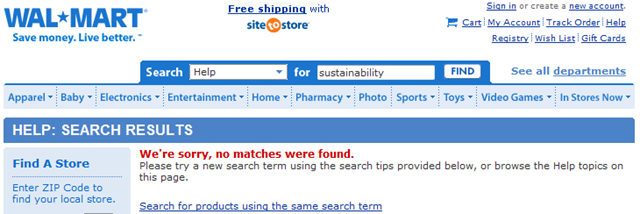
Future will tell, and I truly hope we are right. Still, I am not totally convinced. I could not find a word about sustainability in the "help/about section" of the Wal-Mart web site, but a search for "sustainability" linked to Wal-Mart Save Money, Live Better.
In any case, it sounds great to be BLUE. And I bet, given the marketing machines involved here, that we will see a lot of BLUE videos, plug-ins, widgets, gadgets, apps, and more. Or, are they already out there?
(by the way BLUE and PSP are not very smart brand names from a Internet search perspective, and I personally do not like commercial appropriation of core words in our languages, i.e, the name of a color or a digit).
The following week I am visiting New York together with a group of bank leaders/managers from Swedbank and the Swedish Savings banks. I have adviced them on the content of this Learning trip and accompany the group as a way to share our learning further. We all look forward to a week full of interesting meetings, visits, and expereinces. Depending on what my customer, our hosts, and I think is OK to share openly, I will publish as much insights as I can here in weconverse.
The focus for our trip is The New Global World, The New Internet, and The Novel Experiences. Anything you want to know/share about that?
 And when I surfed there I was stunned – not inspired. The site seems to be a blog with three (3) posts and an abundance of meta stuff (tags, key words, microsoft links, menu choices, etc). You offer me to Join and Sign in. Why should I?
 The top of the page is filled with something that resembles a banner, but I cannot click it. Maybe I can if I sign up/in (irony). Instead I opted to click the "Developers" item in the menu.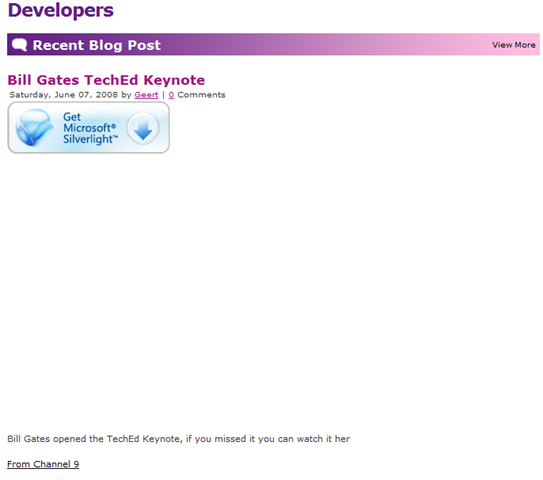
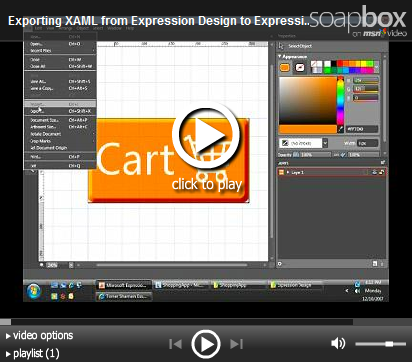 Next up on the inspiring category is hopefully something that leaves developers with their mouths wide open and salivating. A wonderful illustration of how to "export XAML from Expression Design to Expression Blend" (see image). But I do not know, I am a humble consultant that advices on strategic market conversations issues. And as such I do not advice anyone to see the "Marketers" section video where "Marc gives us a summary on everything that went on in Cannes". He simply tell (not show) what Microsoft did there, and I know more things happened in Cannes. For example, Microsoft got a share of the Grand Prix for film lions (ironically in Quicktime format). In the end the proof of the pie is in the eating (ask Yahoo). If you want to get even more inspired, read and watch how I sold a 60 second spot in my gig on a event for Microsoft’s advertising customers.




 Inlägg (RSS)